
El Paso County Court Records After a Jail Arrest
Court records after a jail arrest in El Paso County usually develop in stages. An arresting agency books the person into the El Paso County Jail / Criminal Justice Center on arrest or booking charges. The jail record can show the booking number, charges as entered for custody purposes, court date, court division, case number when available, bond type, bond amount, holds, warrants, and release information. Those details are useful, but they are not the final court case.
The formal criminal case is driven by the Colorado 4th Judicial District court system and the 4th Judicial District Attorney's Office. The District Attorney, not the arresting officer, makes the final decision about whether and what felony charge is filed. For custody status, booking fields, and bond rows, use jail inmate records. For booking-photo limits and request routes, use jail roster mugshots. For the filed accusation, hearing history, charge status, and disposition, use the court record.
Arrest to Booking to Court Records Pathway
The pathway starts with arrest and booking. The sheriff's Intake and Release records are updated for court appearances, new charges, bond changes, work release fees, pretrial services, and holds from other agencies. A person may be booked on one set of suspected charges, then see different charges once the prosecutor reviews the case. That difference matters because booking entries describe custody, while court records describe the prosecution.
- Arresting officers book the person into the El Paso County Jail / Criminal Justice Center.
- The jail roster may display custody charges, bond type, bond amount, court date, court division, and court case number.
- Most arrestees with a zero-bond or no-bond posture go to court at 8:30 a.m. the business morning after arrest, according to the sheriff's bonding/advisement material.
- The District Attorney reviews law-enforcement submissions. Felony Intake may ask for more investigation before filing.
- If charges are filed, the case enters county court or district court depending on charge level and procedure.
- The court docket tracks settings, advisements, bond orders, amendments, dismissals, pleas, trial settings, warrants, and disposition.
How to Search Court Records After an El Paso County Arrest
The Colorado Judicial Branch docket search is the public statewide starting point for docket entries. It is not the same thing as a document-copy portal, and it does not replace a court records request. The search works best when the jail roster has already supplied a court date, case number, court division, or the defendant's exact name.
The Colorado Judicial docket search page is the source for the public search fields below.
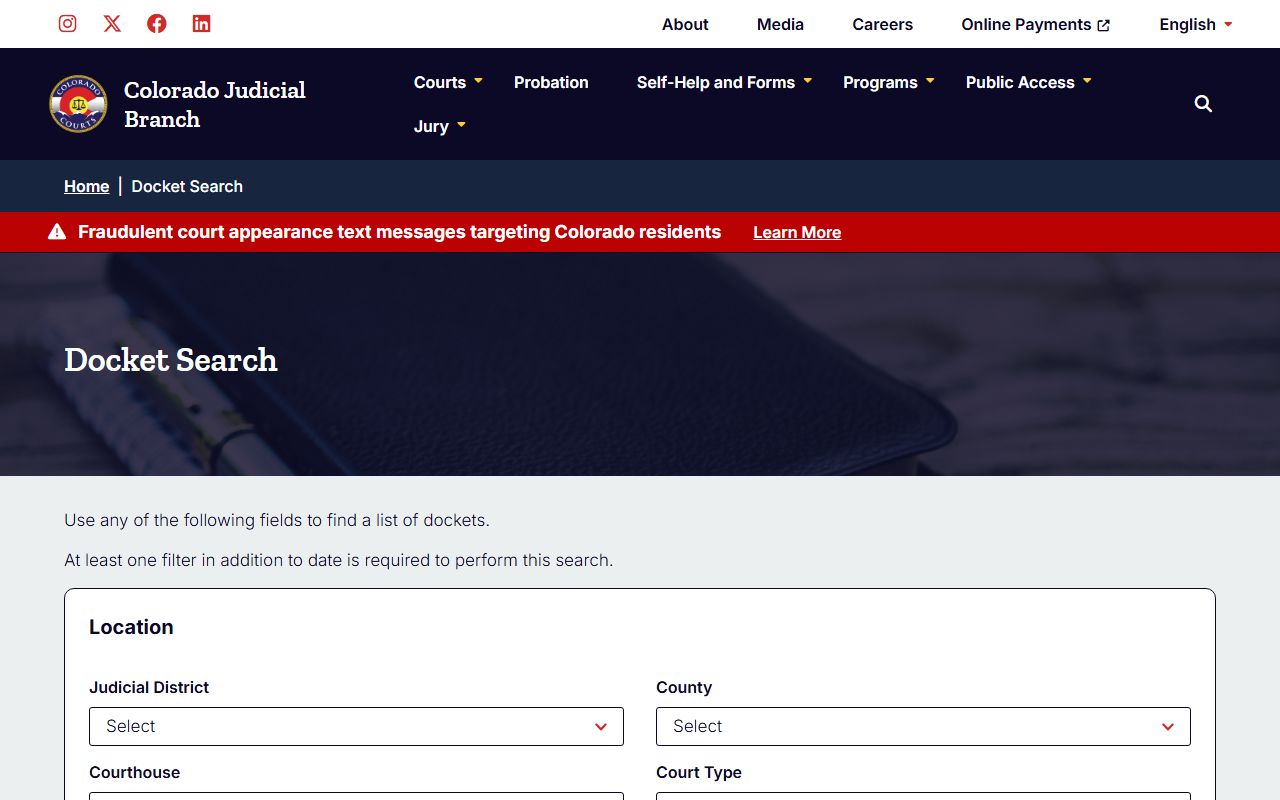
Use at least one filter in addition to date. For an El Paso County jail arrest, selecting the 4th Judicial District and El Paso County helps keep Teller County or statewide matches from crowding the results.
| Search Field | How to Use It | Why It Matters After Arrest |
|---|---|---|
| Judicial District | Select 4th Judicial District. | The district covers El Paso and Teller counties. |
| County | Select El Paso County. | Localizes the search to the arrest county when the case is filed there. |
| Courthouse | Select El Paso County Judicial Building when available. | Matches the local court location at 270 S. Tejon Street. |
| Court Type | Choose County, District, or Both. | County court and district court handle different criminal stages and charges. |
| Date Range | Use today, one week, one month, three months, six months, or a specific date. | The jail roster court date can guide this filter. |
| Case Number | Enter year, class, and sequence if known. | The jail roster case number is the strongest bridge to the court file. |
| Party Name | Search individual first and last name. | Useful when no case number has posted yet. |
| Attorney | Search by bar number or attorney name. | Helpful after counsel appears in the case. |
El Paso County Court Records Requests After Arrest
When docket entries are not enough, request the court file from the El Paso County Combined Court. The local Colorado Judicial Branch page lists the El Paso County Judicial Building at 270 S. Tejon Street, Colorado Springs, CO 80903. Clerk and self-help hours are Monday through Friday, 7:30 a.m. to 4:30 p.m. Records questions go to 719-452-5490, and records requests may be emailed to 04ResearchRequest@judicial.state.co.us, submitted through the online records request link, or made in person in Room S101.
The Colorado Judicial Branch El Paso County court page is the source for local records request routing.
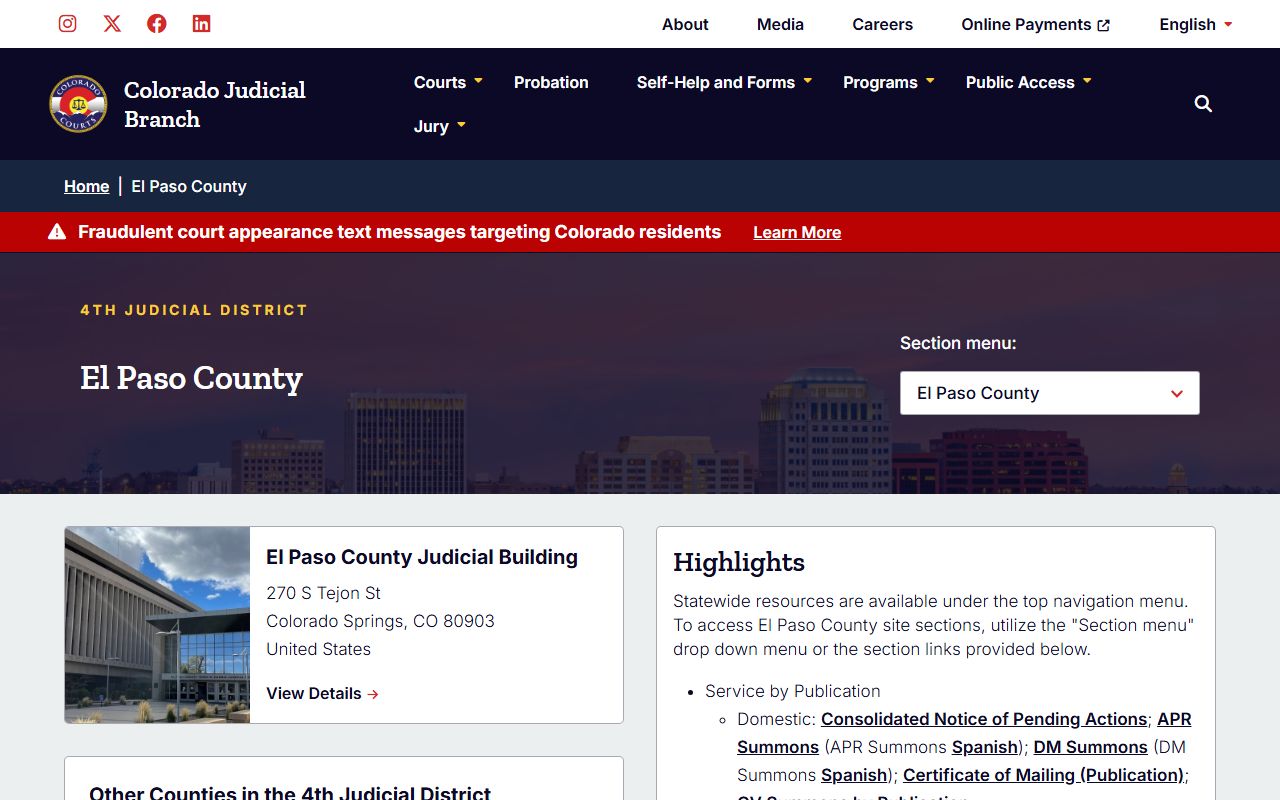
Use the court request process for complaints, informations, indictments, minute orders, bond paperwork, dispositions, and other court documents. The Judicial Branch access guide explains that online vendor searches do not provide copies of case documents. Older, sealed, restricted, suppressed, juvenile, or active-case records may require clerk handling and redaction.
County Court vs. District Court After a Jail Arrest
El Paso County is part of Colorado's 4th Judicial District. County court commonly handles misdemeanors, traffic matters, and early felony complaint proceedings. District court handles felony criminal cases, including the more serious and violent felony dockets. A felony complaint can begin in county court for preliminary procedures and later move to district court when the case posture requires it.
The District Attorney's County Court Unit prosecutes misdemeanor and traffic offenses in El Paso and Teller counties. The District Court Unit handles serious felony prosecutions, including murder, kidnapping, sexual assault, arson, robbery, and burglary, and the DA research source notes 19 felony court divisions. Search both court types if the jail roster does not make the case level clear.
District Attorney Felony Intake and Filed Court Records
The 4th Judicial District Attorney Felony Intake page explains the local charging role after a felony arrest.
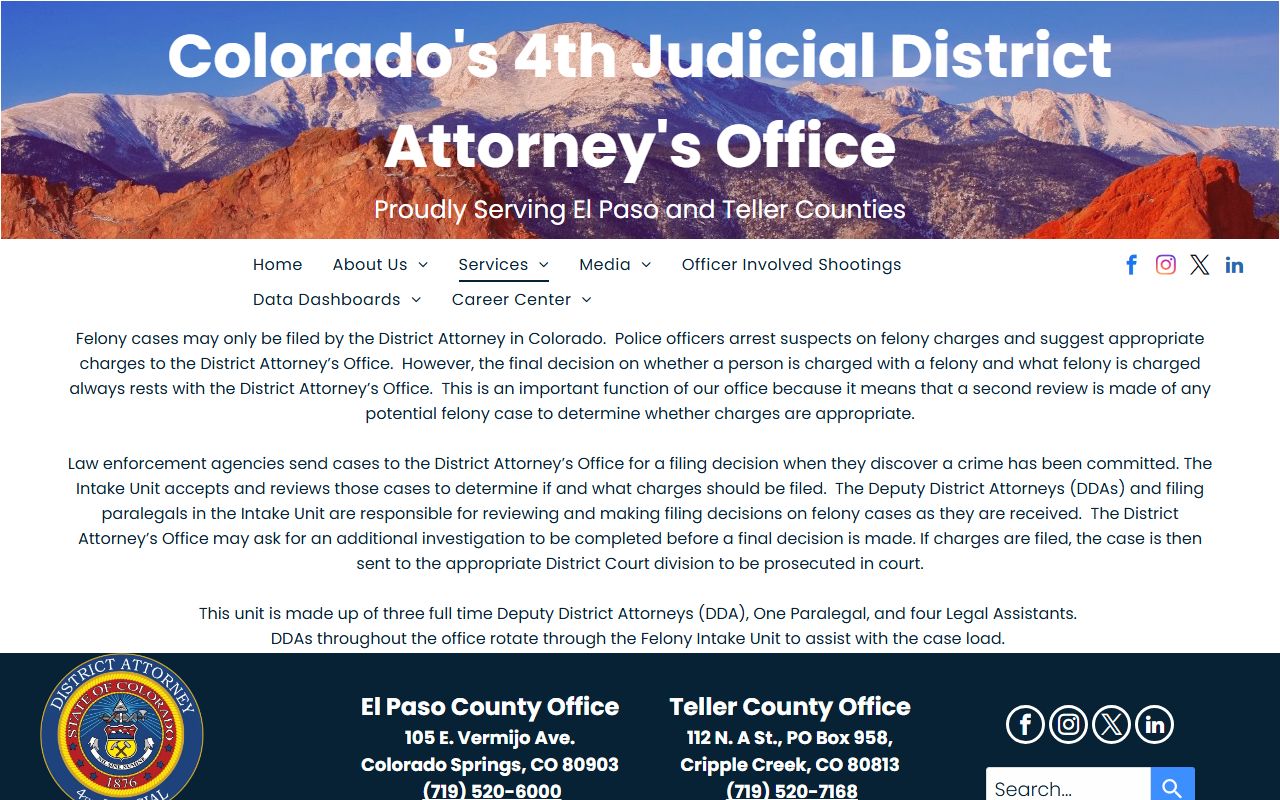
Colorado's 4th Judicial District Attorney's Office serves El Paso and Teller counties. The El Paso County office is at 105 E. Vermijo Ave., Colorado Springs, CO 80903, and the main phone is 719-520-6000. District Attorney Michael J. Allen was sworn in as elected DA on January 12, 2021. For court records after a jail arrest, the key point is that law enforcement submits the case, Felony Intake reviews it, and the prosecutor decides whether to file, decline, amend, add, or reduce charges.
Charging Documents After Arrest: Complaint, Information, and Indictment
Colorado criminal prosecution may begin by indictment, information in district court, felony complaint in county court, or complaint/summons procedures for misdemeanors, petty offenses, and civil infractions under C.R.S. 16-5-101. A summons can create a court case without a matching current jail booking, while a jail arrest can begin with booking charges that later change after prosecutor review.
| Document | Who Uses It | Common Role After Jail Arrest |
|---|---|---|
| Complaint | Prosecutor or law-enforcement based filing, depending on case type and procedure. | Can start misdemeanor, petty, traffic, civil-infraction, or felony complaint proceedings. |
| Information | Prosecutor. | Often used to file felony charges in district court after DA review. |
| Indictment | Grand jury. | Grand-jury charging document, usually associated with more serious or complex prosecutions. |
Charge Status in Court Records After Arrest
Charges can move quickly after booking. A jail roster row might list the suspected offense used for intake, while the court file shows the charge the prosecutor actually filed. Later docket activity may amend or reduce a charge through plea negotiation, dismiss a count, add a count, or enter a conviction after a plea or finding.
| Status | What It Means | What to Check |
|---|---|---|
| Pending | The case or charge has not reached final disposition. | Next hearing date, bond order, and active warrants. |
| Amended | The filed charge changed after the original filing. | Latest complaint, information, or minute order. |
| Reduced | The charge level or offense changed to a lower charge, often through plea or amendment. | Plea paperwork and disposition entries. |
| Dismissed | The court or prosecutor ended that charge without a conviction on that count. | Whether other counts remain pending or resolved. |
| Conviction | A guilty plea, guilty finding, or other formal adjudication was entered. | Sentence, probation terms, fines, and appeal or sealing eligibility. |
| Disposition | The final outcome of a charge or case. | Certified disposition if an official copy is needed. |
Charges vs. Convictions in Court Records
An arrest and a filed charge are not the same as a conviction. A charge is an accusation that must be handled in court. A conviction requires a plea, verdict, or other formal adjudication. Treating a booking charge as a conviction is inaccurate, especially in the early period between jail booking, first appearance, DA filing, and later hearings.
| Charge | Conviction | |
|---|---|---|
| Stage | Accusation filed or listed before final outcome. | Final adjudication through plea, finding, or verdict. |
| Proof | Based on probable cause and prosecutor filing standards. | Based on guilty plea or proof beyond a reasonable doubt. |
| Record Meaning | Shows what was alleged or pending. | Shows legal responsibility for the resolved offense. |
| Custody Link | May appear beside bond and court date on the jail roster. | May affect sentence, probation, DOC transfer, or release conditions. |
Bond, Advisement, and Release After Arrest
Bond information often appears in both jail and court records. EPSO says bonds can be posted 24 hours a day, and online card bond payments require calling 719-390-2142. Cash, money order, and credit/debit card options are described by EPSO, subject to card policies. A payer should confirm the bond before acting because the sheriff warns users not to take official action from web data alone.
EPSO's bonding material states that bond fees, booking fees, and other debts do not have to be paid to secure release on a money bond. The payer needs to pay the bond amount. EPSO also notes a $10 bond fee and a $30 booking fee as debts that may be charged after release, but the same materials say those fees do not have to be paid to secure release. Someone posting a money bond has the right to bond paperwork that includes the next upcoming court date.
| Bond Type | How It Works | Common Caution |
|---|---|---|
| Personal Recognizance | Judge authorizes release on signature without posting money. | Nonappearance can trigger penalties or warrant action. |
| Cash or Money Bond | The set amount is posted with the holding county to secure release. | Pay to the county, not to the incarcerated person. |
| Surety Bond | A bondsman may post unless the court orders cash only. | EPSO notes typical private fees of 10 to 15 percent plus possible collateral. |
| Zero Bond or No Bond Hold | No bond can be posted until court authorizes one. | Usually requires first appearance or action by the issuing court. |
| Other-Agency Hold | Another county, DOC/parole, federal, or other agency controls part of custody. | Release may not occur even after the local bond is posted. |
Warrants Connected to Court Records After Arrest
No current official El Paso County Sheriff public active-warrant search portal was located in the research. The jail roster can show warrant rows for a person who is already in custody, including warrant number, description, and level. That is not the same as a countywide public search for all outstanding warrants.
Use the court docket for case-related warrant settings, bond changes, failure-to-appear activity, and hearing status where public. For custody confirmation, call the booking desk at 719-390-2151 before acting. For releasable criminal justice records, use EPSO's CCJRA/CORA records process. Municipal warrants may need the relevant municipal court or police department, and DOC parole absconders are tracked through state DOC fugitive channels.
Sealed vs. Expunged Court and Arrest Records
Colorado uses court-ordered sealing for many arrest and criminal case record issues. The Colorado Bureau of Investigation explains that arrest-record sealing is handled through the court where the records were filed, with C.R.S. 24-72-703 identified as a key statute. As of July 1, 2024, CBI no longer takes a sealing fee, though fingerprint vendors or agencies may still charge their own fees.
| Sealed | Expunged | |
|---|---|---|
| Plain Meaning | Hidden from ordinary public access by court order. | Commonly used for records treated as removed or erased, but Colorado adult arrest relief is usually described as sealing. |
| Public Search | May no longer appear to the general public after the order is processed. | Depends on the specific Colorado procedure and record type. |
| Government Access | Certain agencies may retain limited legal access. | Any remaining access depends on statute and the type of case. |
| Where to Start | The court where the case or arrest record was filed. | Confirm whether the case is eligible for expungement or sealing under Colorado law. |
Do not assume a dismissal instantly removes every public trace. A dismissal may support later sealing, but the sealing order and record-custodian processing are separate from the dismissal entry.
Public Access Limits for Court Records After Jail Arrest
Colorado public access rules split records by custodian and record type. CORA covers many noncriminal public records. The Colorado Criminal Justice Records Act covers sheriff and law-enforcement criminal justice records. Court case documents are requested from the Colorado Judicial Branch or the court location. Jail daily records have their own public-record requirements under C.R.S. 17-26-118, including data such as entrance date, name, date of birth, charges, bond, release date, capacity, population, bookings, and deaths.
Access note: Records of official actions have stronger public-access status, but active investigations, juvenile matters, sealed cases, suppressed material, sensitive victim information, and restricted documents may be withheld or redacted under Colorado law.
Background Check Use and FCRA Limits
A casual docket search or jail lookup is not the same as a legally compliant background check. Employers, landlords, insurers, lenders, and other regulated users must follow the Fair Credit Reporting Act and any applicable Colorado or federal requirements. Always verify filed charges and dispositions with the originating court before relying on a record for legal, screening, or official purposes.
Important: This website is not a consumer reporting agency and cannot be used for employment, tenant, credit, insurance, or other FCRA-covered screening.